Industry News
7m Pipeline Positioning Lift: Mobile, Modular, Adjustable
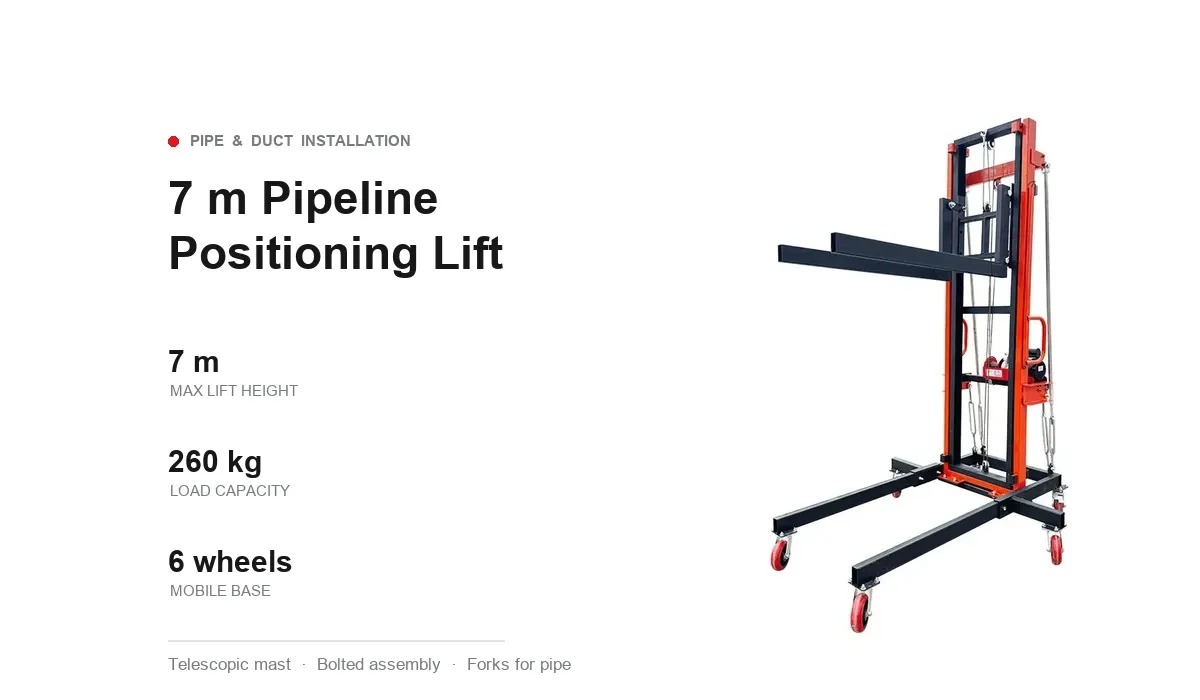
A pipeline positioning lift raises fire-protection pipe and HVAC duct to 7 m at 260 kg — on a six-wheel base that moves between work points instead of a scaffold that does not.
The job is not lifting. It is holding a long object still, seven metres up.
Ask an installer what goes wrong on a high-level pipe run and the answer is rarely about strength. A six-metre length of steel pipe weighs less than two people can comfortably carry. The problem is that a pipe has to arrive at its hangers level, aligned, and motionless — and it has to stay there while somebody else does the fixing.
That is a different requirement from carrying something. It is a positioning problem.
A pipe held by two people on two ladders is held by two points that are both moving. Every adjustment at one end is a disturbance at the other. The longer the run, the worse the leverage, and the more the far end swings while you try to seat one clamp.
The equipment built for this is a pipeline positioning lift — an electric material lift with a multi-stage telescopic mast, forward-reaching forks and a wheeled base. This article is about what that configuration actually solves, and where it stops being the right tool.
Three installations that share the same failure mode
Fire-protection pipework
Sprinkler mains and branch lines run at ceiling level through occupied and unfinished buildings alike. The pipe is long, the hangers are set at intervals, and each hanger demands the pipe to be presented at the exact height and angle before the clamp closes.
Two characteristics make this hard. First, the working height is rarely convenient — high-ceiling warehouses, atria and industrial buildings routinely put the branch line above four metres. Second, a single length of pipe spans several hangers, so fixing one end while the other is unsupported is not a stable operation.
HVAC and ventilation ductwork
Rectangular duct sections are worse than pipe in one respect: they have flat faces and no round profile to roll against. A duct that is slightly off-level will not self-settle; it has to be held, squared, and bolted to the next section at both flanges.
Duct runs also tend to be off-centre from the building structure, which means the lift has to reach forward from a position the installer can actually stand in.
Building-services pipework
Chilled water, condenser water, drainage and gas lines share the same geometry with different weights and different joint types. Threaded, grooved and welded joints all need the two pipe ends co-axial before the joint is made — and co-axial at four metres means the pipe has to be held, not just raised.
Why the mechanism is a fork and not a platform
This is the detail that separates a pipe lifter from a general material lift, and it is worth understanding before comparing specifications.
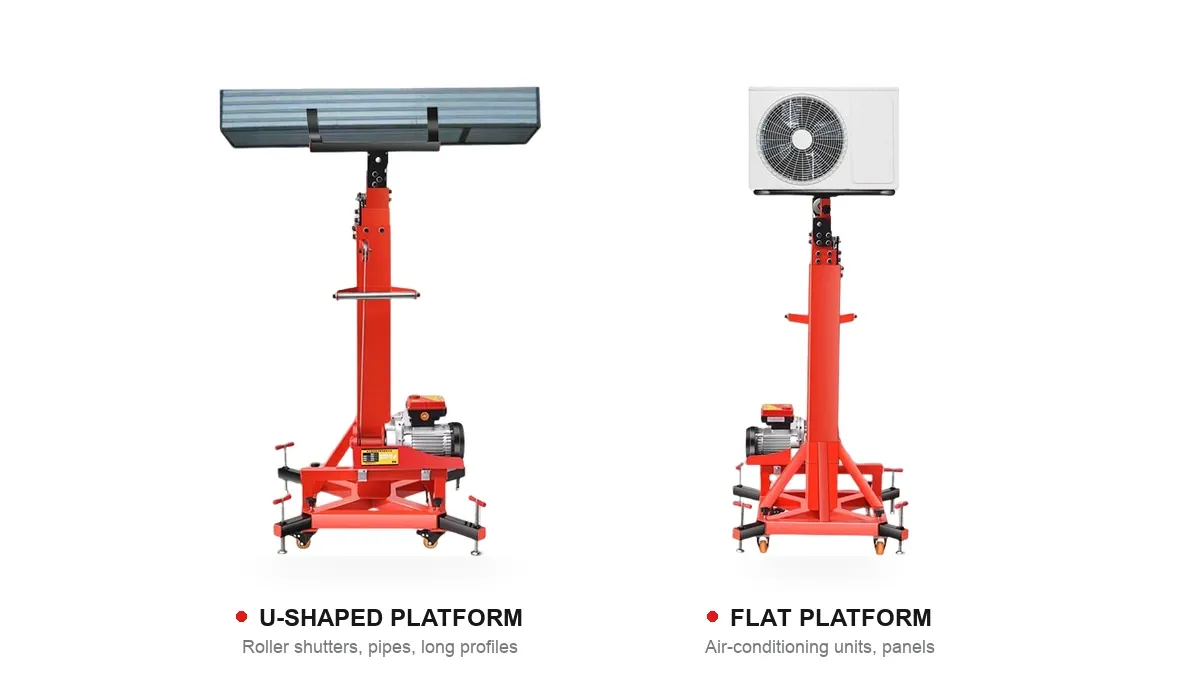
A platform lifts a load by setting it down on a surface. That works for anything with a flat bottom and a stable centre of gravity — an air-conditioning condenser, a panel, a crate. It works badly for a pipe, because a round object on a flat deck is a rolling object, and any roll at the top of a lift becomes a lateral displacement at the far end of a six-metre run.
A fork lifts from below. Two forward-reaching tines slide under the load, and the pipe or duct rests across them. The load is captured along its length rather than balanced on a point.
There is a second consequence that matters more in practice. Forks can be raised into the space between the floor and the installed pipe run, then brought up under the load. A platform has to be swung into position from the side or lowered from above. In a ceiling void full of already-installed services, approach from below is often the only approach available.
What the forward reach costs, and how the base pays for it
A load carried on forks that reach forward from the mast is a load hanging outside the machine's footprint. That creates an overturning moment, and the moment grows with both the load and the distance the forks extend.
The base is the answer. On the 7 m model, the base is a six-wheel trolley: a pair of main wheels at the mast plus four wheels on forward-extending legs. The legs put support out in front of the load's centre of gravity, so the machine resists tipping forward instead of relying on the operator's weight on a handle.
This is also why the wheel count is not a marketing number. Six contact points spread the load across the floor and keep the frame from rocking on uneven ground, which a four-wheel dolly on a concrete slab with a drain channel will do.
Two practical rules follow directly from this geometry.
Keep the load over the legs, not past them
The further forward the load sits on the tines, the greater the moment the legs have to resist. Load the pipe so its centre of gravity sits within the support area the legs define, and confirm the load position against the machine's approved loading conditions rather than judging it by eye.
Set the legs before you raise
The forward legs are also the machine's stabilisers. Extend and set them on firm, level ground before lifting, and check that the surface will carry the combined machine and load weight — 162 kg of machine plus up to 260 kg of pipe is a point load that a suspended floor or a soft excavation will not always accept.
Height: a range, a model, and a mast
Three different numbers get confused in a conversation about lifting height, so separate them.
The series covers 3.5 m to 7 m — six models
The Installation Lifter range runs from a 3.5 m model up to the 7 m model through 4 m, 4.5 m, 5 m and 6 m versions. That is a product family spanning a range, not one machine adjustable across it. If you need 7 m, you need the 7 m model.
A single machine adjusts continuously within its rating
At the same time, height is not a fixed notch on one machine. The mast is multi-stage and telescopic, so the forks can stop at any working height up to the rated maximum. That is what makes the tool useful in the field: the same machine sets a pipe run at 3.2 m in one bay and a branch line at 5.8 m in the next, without swapping equipment.
Keep the distinction straight when you compare suppliers. A quotation for "3.5 to 7 m" describes a family; a quotation for one machine should name its maximum lifting height and the reference point that height is measured from.
3.98 m of machine to reach 7 m
The 7 m model lists a self height of 3.98 m against a maximum lifting height of 7 m. That ratio — roughly 1.76 to 1 — is the whole point of a telescopic mast, and it is where the transport problem begins.
A single-stage mast reaching 7 m would be a 7 m piece of steel that has to be moved, stored and stood up. A telescopic mast collapses to 3.98 m, and 3.98 m is still taller than a doorway, taller than a lift car, and taller than most vans.
Why the machine is built to come apart
That height figure explains the design decision that buyers usually notice second and value first: the 7 m unit is a bolted, modular assembly, not a welded one-piece frame.
Because it has to get to the job
A 7 m lift cannot be carried through a 2.1 m door, up a stair core, or in a standard panel van while assembled. On a fit-out project that means the machine has to arrive at the floor in sections and be assembled where the work is.
Because the mast sections are separate parts
The mast stages, the base legs and the fork carriage are bolted together. That gives three practical advantages beyond transport: a damaged or worn section can be replaced without scrapping the assembly; the machine can be reconfigured for access; and the same base can carry a different mast height within the range.
What "easy to assemble" should mean in a quotation
Assembly time is a claim worth testing rather than accepting. Ask the supplier three questions: how many separate components does the unit arrive in; what does each component weigh, because a part nobody can lift is not portable regardless of the machine's total weight; and what tools are required.
We would rather state the design principle than promise a number. The unit is built as a bolted assembly; the sectional breakdown, component weights and assembly method for the configuration you order should be confirmed in writing before the machine ships.
Mobility: what the six wheels buy you, and what they do not
Moving between work points is the daily cost
On a fire-protection install, one floor might have thirty hanger positions and four risers. The equipment that lifts at each of those points has to move between them, and the move happens many times a day.
This is where the wheeled base earns its place over a scaffold. A scaffold positioned for one bay is a fixed resource: moving it is an erection and dismantling job, so crews tend to leave it and work around it. A trolley-based lift relocates in minutes and takes up floor space only where it is working.
Electric lifting is not powered travel
One clarification worth making because it appears in RFQs: the machine lifts electrically. The base is a trolley, moved by hand. It is not a self-propelled vehicle, and it does not have forklift mobility or forklift reach. Confirm the movement arrangement for the model supplied rather than assuming powered drive from the word "electric".
Floor conditions set the limit
Six wheels handle a rough slab better than four, but they do not make the machine an all-terrain unit. Firm, level, load-bearing ground under the base is a working requirement, not a preference. Soft excavation, suspended access floors, scaffolding decks and gradient changes are conditions to raise with the supplier before the machine arrives on site.
What a pipeline positioning lift replaces — and what it does not
Against ladders and manual handling
Two people, two ladders and a length of pipe is the default method and it costs nothing to hire. It also has no way to hold the load during fixing, requires both people for the whole operation, and puts the heavier end of a lever arm at shoulder height.
The lift converts the job to one operator positioning and one person fixing, with the load held where it was set.
Against scaffolding
Scaffold is the correct answer when people need to work at height for hours across a large area. It is the wrong answer for a pipe run that needs ten minutes of lifting per position.
Against a scissor lift or boom lift
Powered access platforms carry a person, which makes them heavier, more expensive, and subject to operator training and ground-bearing requirements. They also need a footprint to set up in, which a fit-out corridor may not have. A material lift carries the load instead of the person and fits into spaces a platform cannot enter.
Against a forklift
A forklift reaches higher and carries more, but it needs a driver, a licence in most jurisdictions, and a clear aisle to operate in. Inside a finished building with installed services overhead, it is usually the wrong tool. The pipeline lift is the tool for that interior case.
Where the machine stops
An honest specification includes the limits, because a lift used outside them is a hazard rather than a tool.
It carries materials, not people. There is no personnel platform in this configuration and the forks are not a working surface. This is a design premise, not a warning label.
260 kg is a rating, not a target. The capacity applies to the load in the approved position on the supplied support arrangement, and it should not be carried across from another model or assumed constant across the whole height range.
Long loads behave differently from heavy ones. A pipe within the weight limit can still be a handling problem if it is unusually long, bulky, or loaded off-centre, because the moment on the forks grows with length. Discuss the actual pipe or duct dimensions — not just its weight — before selecting the model.
Overhead obstructions limit the working envelope. Ceiling voids full of installed services constrain both the mast height and the approach path. Check the actual void rather than the drawing.
Specifying one: five questions that settle the model
The specification follows from the job, not the catalogue. Answer these and the selection narrows quickly.
What is the fixing height? The hanger or flange height, plus the depth of the object, plus a working margin — measured on site.
What does the section weigh, and how long is it? Weight sets the model class. Length sets whether the forks can carry it and where its centre of gravity will sit.
What is the pipe or duct profile? Round pipe and rectangular duct need different support arrangements. Confirm the load support for the actual profile.
Can the machine get in? Door widths, lift car dimensions, stair cores and floor loading decide whether an assembled unit can be used or whether it must arrive in sections.
What is the power supply? Voltage, phase and frequency must match the destination market, and on a fit-out the supply may be temporary.
Frequently asked questions
Can one person operate the lift and install the pipe?
One person can move and raise the lift. The fixing step still benefits from a second person at the pipe end, particularly on a long run where both ends have to be seated simultaneously. The lift removes the need to hold the weight, not the need for a second pair of hands at the joint.
Is the 7 m model adjustable down to 3.5 m?
No — the 3.5 m to 7 m span describes the model range. The 7 m model lifts to 7 m and its mast telescopes continuously below that, but it is not the same machine as the 3.5 m model. Choose the model for your highest fixing point and accept the extra machine height that comes with it.
How long does assembly take?
That depends on the configuration and the crew, and we would rather you get the real figure for your unit than a number from a brochure. Ask for the component list, the weight of the heaviest single part, and the assembly procedure for the specific model at quotation stage.
Can it lift a duct section that is wider than the forks?
The forks support from below along their length, so the load can overhang the tine spacing to a degree — but the further it does, the more the load's stability depends on how it is secured. Confirm the duct width and the intended support arrangement with the supplier rather than assuming the forks will take it.
Does it work outdoors?
It works on firm, level ground in dry conditions. Wind acting on a long, light duct section is the practical constraint outdoors, and the machine is not designed for soft or sloping ground. Plan outdoor work around the weather rather than the machine.
Getting the pipe to the hanger
The recurring theme across all of this is that high-level pipe and duct work fails at the point of presentation, not the point of lifting. The load has to arrive at the right height, in the right attitude, and stay there.
A pipeline positioning lift is built around that single requirement: forks that carry a long object along its length, a telescopic mast that reaches the fixing height and stops anywhere below it, a six-wheel base that supports the forward reach, and a bolted assembly that lets a 7 m machine get into a building it could never enter assembled.
The installation lifter range covers the 3.5 m to 7 m models, including the 7 m heavy-duty electric pipeline positioning lift described above and the 6 m electric fire pipe stacker for ceiling-level work. If your installation is interior fit-out with boxy loads rather than long ones, the guide to the mini vertical lift and its two platform types covers the flat-versus-U-platform decision.
To size a lift against a specific pipe run, send us the fixing height, the pipe or duct dimensions, the section weight and your power supply and we will confirm the model and support arrangement that fits.